5.1.1. Simple wave equation in one dimension
Let us start with a simple wave equation
Upon multiplication with the test function \(w\) and partial integration, one obtains the weak form
In pyoomph, we just can use partial_t() for the time derivative and do the spatial part as before in Section 4. For the bulk contributions, i.e. the \((\cdot,\cdot)\) terms, we write again a Equations class:
from pyoomph import *
from pyoomph.expressions import *


class WaveEquation(Equations):
	def __init__(self,c=1):
		super(WaveEquation, self).__init__()
		self.c=c # speed

	def define_fields(self):
		self.define_scalar_field("u","C2")

	def define_residuals(self):
		u,w=var_and_test("u")
		self.add_residual(weak(partial_t(u,2),w)+weak(self.c**2*grad(u),grad(w)))
It is essentially the same approach as in Section 3. The problem class could read as follows
class WaveProblem(Problem):
	def __init__(self):
		super(WaveProblem, self).__init__()
		self.c=1 # speed
		self.L=10 # domain length
		self.N=100 # number of elements

	def define_problem(self):
		# interval mesh from [-L/2 : L/2 ] with N elements
		self.add_mesh(LineMesh(N=self.N,size=self.L,minimum=-self.L/2))

		eqs=WaveEquation() # equation
		eqs+=TextFileOutput() # output
		eqs+=DirichletBC(u=0)@"left" # fixed knots at the end points
		eqs+=DirichletBC(u=0)@"right"

		# Initial condition
		x,t=var(["coordinate_x","time"])
		#u_init=exp(-x**2) # This has no initial motion, i.e. partial_t(u)=0
		u_init=exp(-(x-self.c*t)**2) # This one moves initially to the right
		eqs+=InitialCondition(u=u_init) # setting the initial condition

		self.add_equations(eqs@"domain") # adding the equation

if __name__=="__main__":
	with WaveProblem() as problem:
		problem.run(20,outstep=True,startstep=0.1)
Note how the initial condition u_init depends on time t, which is bound by var("time") again. Thereby, we ensure that we have a traveling wave solution. Besides the initial condition \(u(x,t{=}0)\), the additionally required first derivative \(\partial_t u(x,t{=}0)\) is automatically evaluated. Indeed the result is, as expected, a traveling wave which is reflected at the boundaries, cf. Fig. 5.1. Without specifying the time dependency of the initial condition, \(\partial_t u(x,t{=}0)=0\) would hold, yielding a different solution.
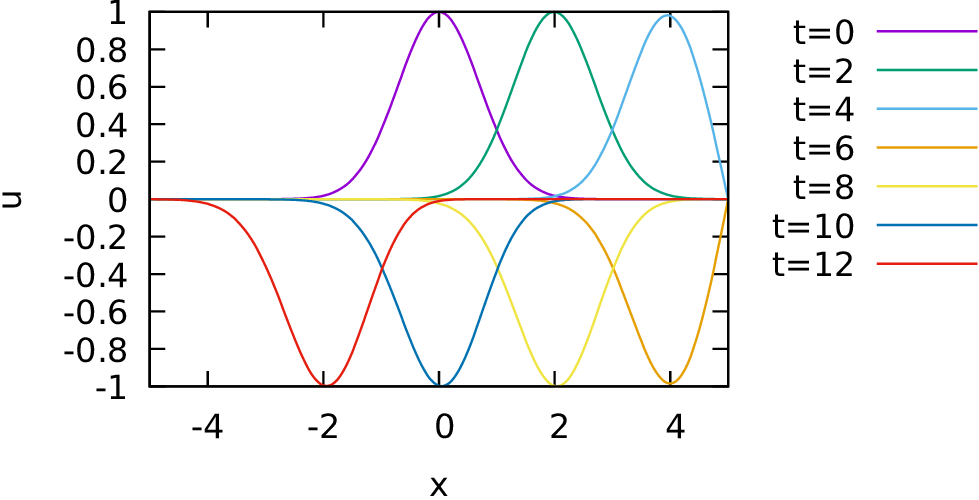
Fig. 5.1 Traveling wave solution, which is reflected at the boundaries.
Without the DirichletBC(u=0) terms, the \(\langle \cdot, \cdot \rangle\) terms in (5.2) would become relevant. Since we do not add any contributions at the boundaries by some InterfaceEquations or NeumannBC, the term \(\langle c^2\nabla u\cdot\vec{n},w \rangle\) is zero. This can only hold for arbitrary \(w\), if \(\partial_x u=0\). Thereby, the wave will have free ends on both sides. The wave gets reflected, but without changing sign.