5.4.3. Coalescence of droplets
For a reasonable coalescence, we have to solve the lubrication equation on a two-dimensional lateral plane. Due to symmetry, only one half of this plane is solved. Of course, it is beneficial to use the spatial adaptivity to resolve the domain accurately and optimize the required computational effort:
from lubrication_spreading import * # Import the previous example problem

class DropletCoalescence(DropletSpreading):
	def __init__(self):
		super(DropletCoalescence,self).__init__()
		self.distance=2.5 # droplet distance
		self.Lx=7.5
		self.max_refinement_level=6


	def define_problem(self):
		self.add_mesh(RectangularQuadMesh(N=[10,5],size=[self.Lx,self.Lx/2],lower_left=[-self.Lx*0.5,0]))

		h=var("h") # Building disjoining pressure
		disjoining_pressure=5*self.sigma*self.hp**2*self.theta_eq**2*(h**3 - self.hp**3)/(3*h**6)

		eqs=LubricationEquations(sigma=self.sigma,disjoining_pressure=disjoining_pressure) # equations
		eqs+=MeshFileOutput() # output
		x=var("coordinate")
		dist1=x-vector(-self.distance/2,0) # distance to the centers of the droplets
		dist2=x-vector(self.distance/2,0)
		h1=self.h_center*(1-dot(dist1,dist1)/self.R**2) # height functions of the droplets
		h2=self.h_center*(1-dot(dist2,dist2)/self.R**2)
		h_init=maximum(maximum(h1,h2),self.hp) # Initial height: maximum of h1, h2 and precursor
		eqs+=InitialCondition(h=h_init)

		eqs+=SpatialErrorEstimator(h=1) # refine based on the height field

		self.add_equations(eqs@"domain") # adding the equation


if __name__=="__main__":
	with DropletCoalescence() as problem:
		problem.run(1000,outstep=True,startstep=0.01,maxstep=10,temporal_error=1,spatial_adapt=1)
We just reuse the previous problem by inheritance to get access to the parameters as e.g. R, sigma, etc. Of course, the parameter distance and the size of the mesh Lx are additionally required. With the max_refinement_level of the Problem base class, the maximum refinement is controlled. The rest is analogous to the previous example, however, in Cartesian coordinates with a 2d mesh and with two droplets.
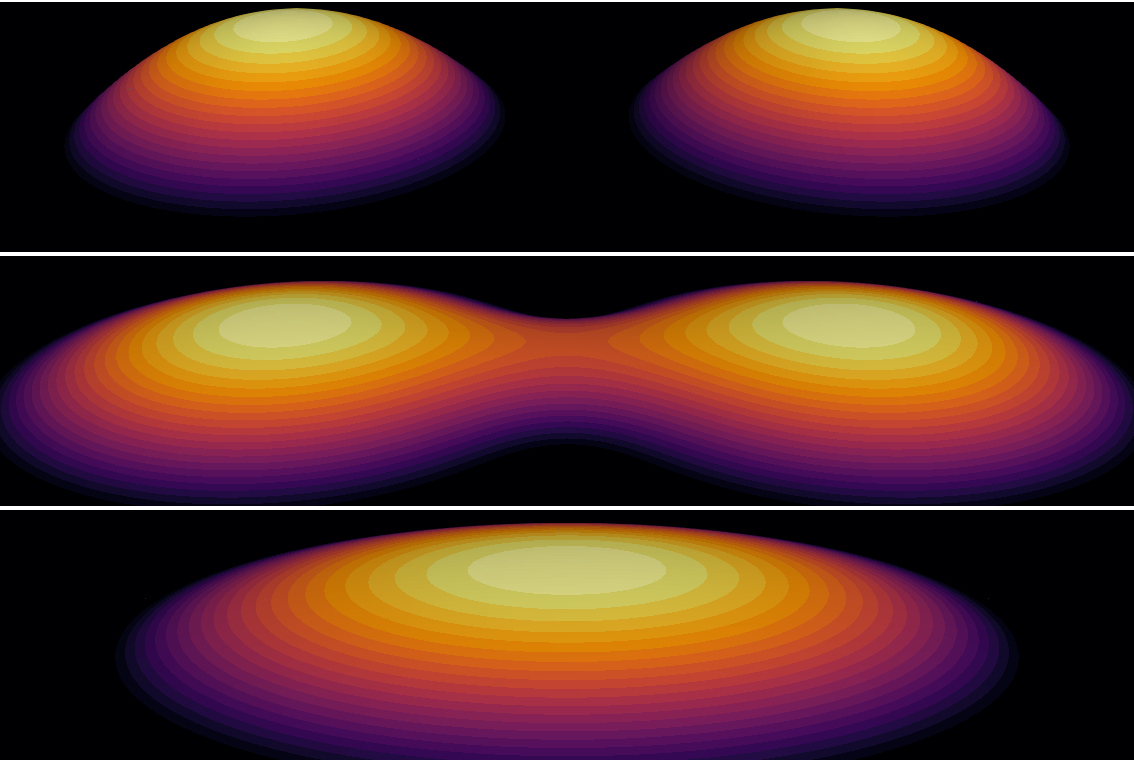
Fig. 5.12 Coalescence of two droplets.
One can rather easily add e.g. (in)soluble surfactants or a mixture composition field by adding a corresponding advection-diffusion field on the domain. When redefining the surface tension sigma to be dependent on this additional field, it is easy to reproduce delayed coalescence due to Marangoni dynamics. Similarly, it is also straightforward to use dimensions here and use the non-dimensionalization in pyoomph to solve the dynamics of real droplets.